+91 9818411155 [email protected]


Sale
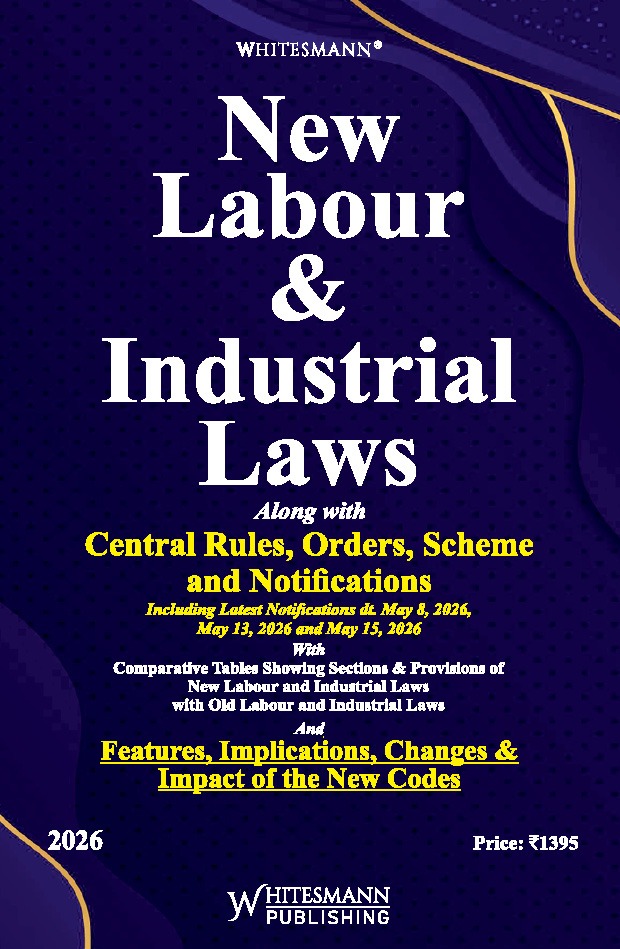
NEW LABOUR & INDUSTRIAL LAWS ALONG WITH CENTRAL RULES, ORDERS,SCHEME AND NOTIFICATIONS
Original price was: ₹1,395.₹1,116Current price is: ₹1,116.
This is a bare-act-style compilation covering India’s four new Labour Codes, which have now replaced the older fragmented labour law framework, along with their freshly notified Central Rules for 2026
Description
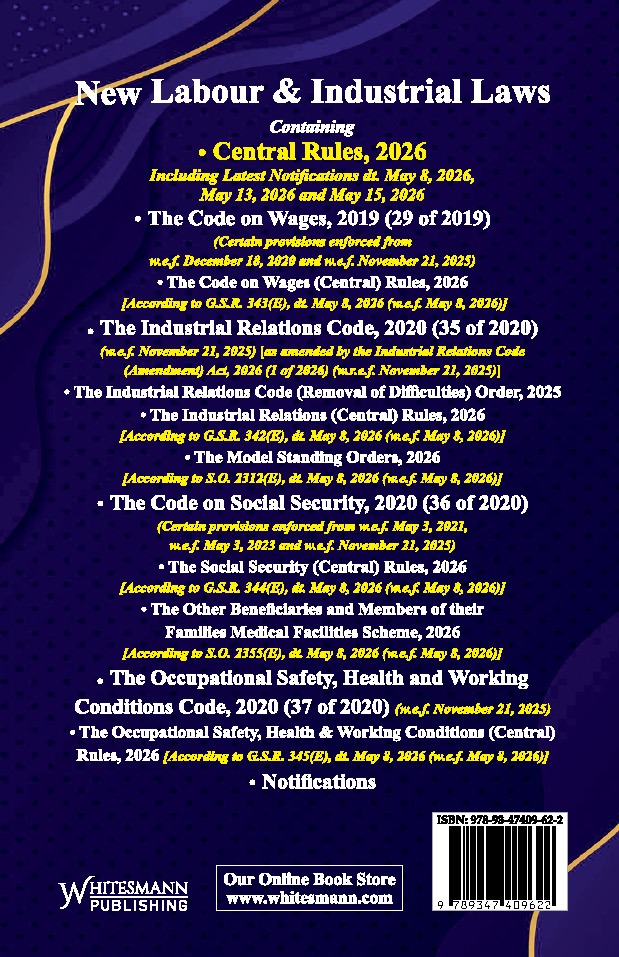
What’s inside
The Code on Wages, 2019 (certain provisions in force from Dec 18, 2020, and Nov 21, 2025)
The Code on Wages (Central) Rules, 2026
The Industrial Relations Code, 2020 (in force w.e.f. Nov 21, 2025), as amended by the Industrial Relations Code (Amendment) Act, 2026
Industrial Relations Code (Removal of Difficulties) Order, 2025
Industrial Relations (Central) Rules, 2026
Model Standing Orders, 2026
The Code on Social Security, 2020 (provisions phased in from May 2021, May 2023, and Nov 2025)
Social Security (Central) Rules, 2026
Other Beneficiaries and Members of their Families Medical Facilities Scheme, 2026
The Occupational Safety, Health and Working Conditions Code, 2020 (in force w.e.f. Nov 21, 2025)
OSH & Working Conditions (Central) Rules, 2026
Plus comparative tables mapping sections of the new codes against the old labour laws they replaced
Notifications, and a section on Features, Implications, Changes & Impact of the New Codes
Why it matters
India’s labour law regime underwent a massive consolidation — dozens of older laws (like the Industrial Disputes Act, Minimum Wages Act, Employees’ Provident Funds Act, Factories Act, etc.) were merged into these four codes. This edition is timely because it captures the most recent 2026 rules and notifications that operationalize provisions which only came fully into force in late 2025.
Who should read/study this
HR professionals & compliance officers — for day-to-day implementation of wage, safety, and industrial relations rules
Labour law practitioners & advocates — for litigation and advisory work under the new codes
Corporate legal teams — to update company policies (standing orders, wage structures, safety norms) per the new framework
Academicians & law students — studying labour law transition from old statutes to codified law
Judicial officers — adjudicating industrial and labour disputes
Trade unions and industry associations — to understand rights/obligations under the new IR Code
Essentially, this is a ready-reference/bare-act compilation rather than a commentary — useful for anyone who needs the exact current text of the codes and rules rather than case-law analysis.
Additional information
| BINDING | PAPERBACK |
|---|---|
| LANGUAGE | ENGLISH |
| EDITION | NEW LATEST 2026 |
| PUBLISHER | WHITESMANN |
You must be logged in to post a review.
![Commentary on RERA The Real Estate ( Regulation and Development ) Act, 2016 in Two Volumes Set Edition 2024 whitesmann [hardcover] Manish Verma & Kush Kalra](https://whitesmann.com/wp-content/uploads/2024/03/WhatsApp-Image-2026-08-03-at-4.53.28-PM-400x611.jpeg)


![CYBER CRIMES & LAWS 4rd Revised Edition By Dr. Santosh Kumar & Dr. Gagandeep Kaur 2026 Edition [hardcover]](https://whitesmann.com/wp-content/uploads/2023/11/WhatsApp-Image-2026-08-03-at-5.07.19-PM-400x611.jpeg)

Reviews
There are no reviews yet.